

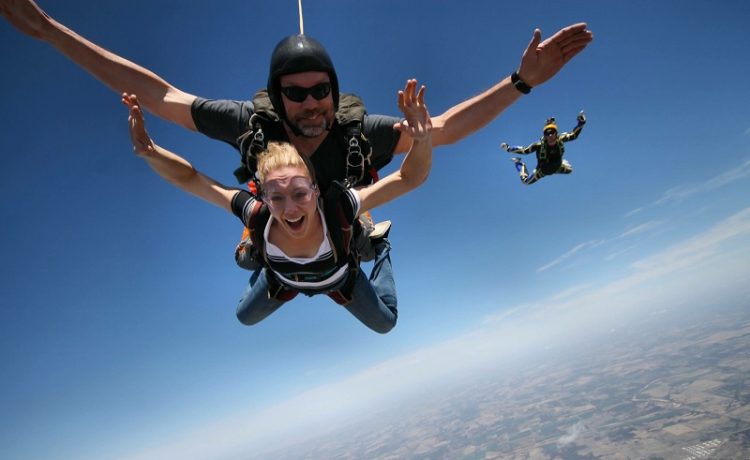
Stepping out of an aircraft at 14,000 feet defies every evolutionary instinct hardwired into the human brain. For millions of years, our survival has depended on keeping our feet firmly planted on solid ground and avoiding fatal plummets. Therefore, the profound anxiety you feel leading up to your first skydive is not a sign of weakness or cowardice. It is simply your nervous system operating exactly as it was designed.
While the physical safety of your jump is entirely in the hands of your tandem instructor and the equipment riggers, your mental state is your responsibility. Skydiving is a deeply psychological experience. The battle is rarely fought in the sky; it is fought in your mind during the days, hours, and minutes leading up to the jump. Preparing your mind allows you to transition from sheer panic to genuine presence, ensuring you actually enjoy the freefall rather than simply enduring it.
Acknowledge and Normalize Your Anxiety
The most common mistake first-time skydivers make is attempting to suppress their fear. Pushing down anxiety only gives it more power, often causing it to manifest as physical tension, nausea, or a paralyzing panic response once you reach the dropzone.
Instead of fighting the fear, you must acknowledge it. Accept that being terrified is a completely rational response to an irrational activity. When your heart rate spikes just thinking about the jump, silently label the emotion. Remind yourself that this adrenaline surge is your body preparing to protect you. By accepting the fear rather than resisting it, you strip away the secondary anxiety—the fear of being afraid—which frees up mental bandwidth to focus on the experience itself.
Strategies for the Days Leading Up to the Jump
Mental preparation begins long before you arrive at the hangar. The way you consume information and manage your thoughts in the week prior will set the baseline for your nervous system on jump day.
Curate Your Information Intake
In the digital age, curiosity often leads to doom-scrolling. If you search for skydiving videos, algorithms will inevitably feed you extreme malfunctions or harrowing close calls because they generate high engagement. You must strictly avoid this type of content. Watching disaster scenarios will only program your brain to anticipate failure. Instead, if you feel compelled to research, watch standard tandem jump videos produced by reputable dropzones. Watch the joy on people’s faces as they land. Condition your mind to visualize a successful, exhilarating outcome.
Build Logical Trust in the Process
Irrational fear thrives in the absence of logic. You can effectively combat pre-jump anxiety by learning exactly how redundant and highly regulated modern skydiving is. Take time to understand the equipment. Learn about the Automatic Activation Device (AAD), a small computer inside every parachute rig that will automatically deploy the reserve parachute at a specific altitude if the instructor is unable to do so. Understand that your tandem instructor has completed thousands of jumps and undergone rigorous certification processes. When the emotional side of your brain begins to panic, you can use these concrete, logical facts to anchor yourself.
The Physiological Link to Mental Resilience
Your mental state is inextricably linked to your physical condition. You cannot expect your brain to remain calm if your body is exhausted, dehydrated, or running on empty.
Many first-time jumpers skip breakfast out of a fear of nausea. This is a crucial mistake. When your body is subjected to a massive adrenaline dump, it requires glucose for fuel. If you jump on an empty stomach, your blood sugar will crash, which drastically increases the likelihood of fainting or severe motion sickness. Eat a normal, easily digestible meal a few hours before your arrival.
Furthermore, you must carefully monitor your caffeine intake. Caffeine mimics the physical symptoms of anxiety—an elevated heart rate, jitteriness, and shallow breathing. If you show up to the dropzone heavily caffeinated, your brain will misinterpret those physical cues as extreme danger, escalating your mental panic. Drink plenty of water and limit yourself to a single, modest cup of coffee if it is part of your daily routine. Absolutely no alcohol should be consumed the night before, as a hangover paired with a skydiving adrenaline rush is a recipe for physical and mental misery.
Managing the Waiting Game at the Dropzone
The skydiving environment is inherently chaotic to an outsider. When you arrive at the dropzone, you will be surrounded by the roar of airplane engines, the frantic packing of parachutes, and the loud, high-energy culture of experienced skydivers. Combined with the potential for weather delays, the waiting period is often reported as the most mentally grueling part of the entire day.
Find Your Anchor and Focus
Do not let the frenetic energy of the hangar hijack your internal state. Find a quiet spot away from the manifest window. Bring a book, listen to familiar music, or simply sit and watch the parachutes land gracefully in the drop zone. Watching others safely complete their jumps is one of the most effective ways to convince your primal brain that the activity is survivable.
Implement Tactical Breathing
When you are called to gear up, your sympathetic nervous system will likely shift into high gear. This is the moment to utilize tactical breathing. Box breathing is the most effective tool to manually lower your heart rate. Inhale deeply through your nose for four seconds, hold the breath in for four seconds, exhale completely through your mouth for four seconds, and hold the lungs empty for four seconds. Repeat this cycle continually while your instructor fits your harness. By controlling your diaphragm, you are sending a biological signal to your brain that you are safe, which prevents the anxiety from spiraling into a panic attack.
Boarding the Aircraft and the Ascent
Walking to the aircraft is the threshold of commitment. The ride up in a small, unpressurized plane like a Cessna or Twin Otter takes roughly fifteen to twenty minutes. It will be loud, cramped, and smell strongly of aviation fuel. As the ground shrinks away, the reality of the situation becomes unavoidable.
During the ascent, lean heavily on your instructor. They are not just parachute pilots; they are highly trained in managing human psychology. Talk to them. Ask them how many jumps they have done or what their favorite part of the job is. Engaging in casual conversation forces your brain to remain tethered to the present moment rather than projecting into a terrifying future. If conversation fails, focus entirely on your breathing and look at the horizon rather than staring straight down at the ground.
The Door and the Art of Surrender
A buzzer will sound, a light will turn green, and the heavy roll-up door of the aircraft will slide open. The sudden rush of freezing, high-altitude air and the deafening roar of the wind is a sensory overload unlike anything else. This is the crux of the mental battle.
As you shuffle toward the edge of the door, attached securely to your instructor, your brain will scream at you to grab onto something. This is the exact moment you must practice radical surrender.
You cannot control the gravity, you cannot control the airplane, and you cannot control the parachute. The only thing you can control is your physical response. Follow your instructor’s exact directions—usually crossing your arms over your chest, tilting your head back, and arching your body like a banana. Do not reach for the doorframe. Do not close your eyes. By physically surrendering your resistance and trusting the professional strapped to your back, you bypass the panic.
The instant you leave the aircraft, the agonizing fear of falling vanishes entirely. Because the plane is already moving forward at roughly one hundred miles per hour, you do not experience the stomach-dropping sensation of a roller coaster. Instead, you feel as though you are resting securely on a massive, roaring cushion of air. The intense anxiety of the preparation is instantly replaced by an overwhelming, electric euphoria.
The mental preparation you endure to get to that door is heavy, but the psychological reward of stepping through it alters your perspective forever. You realize that the boundaries of your courage are vastly wider than you ever imagined, and the fear that once held you back was simply the final hurdle before true freedom.